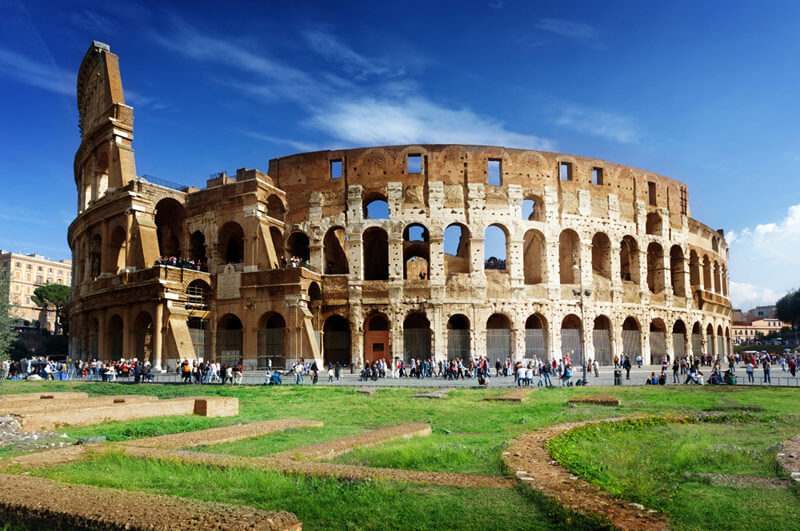
The Roman Forum was once the center of life in Rome and the Roman Empire, later a run-down and abandoned place in the city, and today it is visited by many tourists and archaeologists. But just walking around old ruins is not interesting. It becomes interesting when you know the history and understand how it is connected with past events and specific people. Then the imagination works more actively and you look at everything with different eyes. Let me clarify that the forum is the central square of the city with several public buildings located on it, where the life of the city was in full swing, as well as street life in the open air, deals, negotiations, etc. The words of famous Roman orators, politicians and knights were heard here, public meetings and celebrations were held here.


The history of the forum dates back to the 6th century BC. Previously, it was a marshy area between three hills - Palatine, Capitoline and Esquiline - which was drained during the reign of Lucius Tarquinius. The reason for the construction of the Forum was trade between the Romans and the Sabines. The fact is that the Romans kidnapped women of the Sabine tribe and either held them as hostages or took them as wives. Finally, these two peoples decided to make peace and build a common market. Later, public meetings - committees - were held at the forum. The forum housed trade stalls, workshops, oratorical tribunes, places for religious celebrations, elections to the chancery and magistrates, meetings of the Senate, and public ceremonies. After the Punic Wars (264-146 BC), active construction began here. This is roughly what the forum once looked like:

The barbarian invasions had a devastating effect on the Roman Forum: in 410, it was the Goths, and in 455, the Vandals. With the fall of the empire, the forum's activity ceased and it turned into a giant quarry. Gradually, part of it was covered with earth and grass. Before the Renaissance, this place was called Campo Vaccino, which meant "cow field". Only in the 19th-20th centuries did archaeologists, architects and restorers begin to restore this magnificent ensemble of ancient, republican and imperial Rome for future generations.
At first, the Romans used wood and brick for construction, fires often broke out in the buildings, so later they switched to more durable and reliable materials - stone and marble.
The ancient arches are the best preserved in the Roman Forum. The Triumphal Arch of Titus is located on the ancient "Holy Way", in the southeastern part of the Forum. (The "Sacred Way" was laid deep into the forum. It was used for the triumphal procession of the rulers of Rome. The procession was led by prominent citizens and politicians, and behind them were carried the trophies they had received. The most important element of the processions was the chariot on which the ruler himself sat. He was dressed in a ceremonial purple robe, wearing a laurel crown and holding a scepter. The prisoners followed the chariot.)

This arch was built by Emperor Domitian in 82 AD to commemorate the triumphant end of the siege of Jerusalem by Emperor Titus. Its height is 15.4 meters, its width is 13.5 meters, its depth is 4.7 meters, and its span is 5.3 meters.
The Triumphal Arch of Septimius Severus is a triple arch in the northern part of the Forum:

The arch was built in 205. It is located on the "Holy Way" between the Curia and the Rostra (the Rostra is a tribune on the Roman Forum, decorated with the prows of ships captured by the enemy). It was dedicated to the triumphal victory of Emperor Septimius Severus and his sons over Parthia. Its height is 20.9 meters, its width is 23.3 meters, its depth is 11.2 meters, and its span is 5.3 meters. The arch depicts episodes of various battles, Roman soldiers and Parthian prisoners, as well as a laudatory inscription to the emperor.
The temples of the Roman Forum have survived only partially, but even their remains and ruins demonstrate their former grandeur. The Temple of Venus Cloacina (Venus the Purifier) was a place of worship of the goddess Venus in ancient Rome. Today, only part of the foundation remains:

The purification of the Romans and Sabines took place here after the latter were kidnapped.
The navel of the city is the ruins of a church from the time of the Republic, of which only the foundation remains:

The Romans believed that the entrance to the underworld was hidden in this stone structure, similar to a covered well. Rituals of worship and sacrifices to the gods were held here.
Temple of Vesta - the ruins of an ancient temple built in honor of Vesta, the god of the family hearth:

It is located next to the Temple of Caesar, south of the "Holy Way". It was first mentioned in the VII century BC. The "Holy Fire" was constantly burning in the temple. Smoke poured out of a hole in the ceiling. Because of this, fires often broke out. In 394, by order of Theodosius the Great, the last emperor of the united Rome, the temple was closed (the emperor was from a Christian family and fought paganism).
Cathedral of Antoninus and Faustina:

This temple was built in 141 by order of Emperor Antoninus in honor of his deceased wife Faustina, and after the death of the emperor it was named in his honor. On the temple there is an inscription: "To the Divine Antoninus and Divine Faustina by decision of the Senate." In the 11th century it was converted into a Christian temple called "San Lorenzo in Miranda", so it is the best preserved temple in the Roman Forum.
The Temple of Venus and Rome is the largest sacred building in Ancient Rome:

The temple was built in 135 during the reign of Emperor Hadrian. The dimensions of the building were 145 by 100 meters. Only some of its elements have survived to this day. It probably used to look like this:

Temple of Caesar (Temple of Deified Julius):

Construction of this temple began in 42 BC. in honor of Gaius Julius Caesar, an ancient Roman politician and knight, after the Senate equated him with a god, on the site where his body was burned and where Mark Antony delivered a eulogy, although the temple was not consecrated until 29 years later. Nowadays, only part of the podium remains.
Temple of Saturn is one of the oldest temples in Rome:

It was built in 489 BC in honor of Saturn, the god of agriculture. Saturnalia is celebrated in its vicinity every year from December 17 to 23. The festival is dedicated to the god Saturn.
Temple of the Dioscuri:

This temple was built in 484 BC by order of the dictator's son Aulus Postumius in honor of the victory over Lucius Tarquinius and in honor of the sons of Jupiter, the twin brothers Castor and Pollux, who allegedly contributed greatly to this victory and brought this news to Rome. In our time, only three columns remain from it, which are called the "Three Sisters". Their height is 15 meters.
Temple of Vespasian:

The construction of the temple was started by the decision of the Senate after the death of Emperor Vespasian in 79 AD in honor of Vespasian and his son Titus and was completed during the time of Domitian, Titus' younger brother. In the building, 33 meters long and 22 meters wide, there were statues of two deified emperors on the podium. It must be said that Vespasian was an intelligent and sensible man. And not without humor. Before his death, he said: "Alas, it seems that I am becoming a god!" To which he added: "An emperor must die standing!" And so he did. Incidentally, Vespasian became the first Roman emperor to be succeeded directly by his biological son, giving rise to the Flavian dynasty. Today, only three 15-meter-high columns remain of the temple.
Temple of Concordia:

The temple was built in 367 BC in honor of Concordia, the ancient Roman goddess of harmony, as a symbol of the end of discord between the patricians and the plebeians. Only a part of the building's foundation has survived to this day.
The Basilica of Maxentius and Constantine is the largest building built on the Roman Forum:

It was built in 308-312. The length of the brick building's foundation was 100 meters, its width was 65 meters, and the nave was 40 meters high. Initially, there was a large statue of Emperor Maxentius, which was later replaced by a statue of Emperor Constantine. Interestingly, during the 1960 Olympic Games, Greco-Roman wrestling competitions were held under its arches.
Basilica Julia:

This building, 101 meters long and 49 meters wide, was built by order of Julius Caesar in 54-44 BC. It was here that the meetings of the Roman Senate and trials related to inheritance and property were held. In 283, the basilica suffered from a severe fire. Restoration was carried out during the reign of Diocletian. Today, the ruins and the 283-year-old central column remain.
Basilica Aemilia:

This three-aisled basilica was built in 179 BC by order of the censors Marcus Aemilius Lepidus and Marcus Fluvius Nobilior. The rectangular building was 100 meters long. It was used as a marketplace, a place for court hearings, and a place for public meetings. As a result of a fire that broke out in 410, the basilica was destroyed and only part of it was restored.
Curia Julia:

Curia is the place where the meetings of the ancient Roman Senate were held. In 283, the building burned down, but was restored. In the VII century, after many reconstructions, it became a Christian temple. The current landmark is a replica of the original building built during the Mussolini era (1932-1937).
Comitium and Speakers' Tribune:

The Comitium is an open space next to the Curia. All important Roman meetings were held here. Later, sacred buildings were built on it, which made the Comitium smaller. The Rostri were tribunes next to the Curia, where orators delivered speeches. Since the 4th century BC, the stands were used to display the bows of captured enemy ships.
The Tabularium is a rare place in the Roman Forum that has partially preserved its ancient appearance:

The Tabularium was built in the 1st century BC. The foundation, first floor, and decorative elements of the interior have been preserved in relatively good condition. The Tabularium was an archive for the Romans, where various legal documents were kept.
The Black Stone, also known as "lapis niger":

The Black Stone is the tomb of Romulus, one of the founders of Rome. The Latin inscription on the stone was probably made between 570-550 BC. The monument was erected on top of the black stone by order of Julius Caesar. According to legend, the inscription foretells a curse on anyone who dares to touch the tomb.
Phocas' Column:

This 13.6-meter-tall column, standing on a white marble pedestal, was dedicated to the Byzantine emperor Phocas in 608. It is the last monument erected in the forum. At its top stood a statue of Phocas, which Flavius Heracles Augustus overthrew in 610 after he executed Phocas and became emperor himself.
Vulcanal:

Vulcanal is a sanctuary of the god of fire Vulcan in ancient Rome. It was one of the oldest sacred buildings in the city. According to legend, the vulcanal was created by Romulus, and it was erected by the legendary king of the Sabines Titus Tatius.
Agrippa's Warehouses:

These are the ruins of food warehouses built by the outstanding Roman statesman and military leader Marcus Agrippa in the 1st century BC. As a result of excavations in the 20th century, 2/3 of these storage facilities were discovered.
Address of the Roman Forum: Largo Romolo e Remo - Via S.Gregorio.
How to get there:
- by metro line B - stop Colosseo;
- by bus №51,75,85,87,118 - stop Colosseo;
- by tram №3,8 - stop Parco Celio.
The historical complex can be visited every day except Mondays from 08:30 to 17:00/19:00, depending on the time of year. Closed: January 1, May 1, December 25.
Ticket price:
- Forum Pass Super Ticket — 18 euros, valid for 24 hours. Includes a guided tour of the Forum, the Imperial Forums, the Palatine Archaeological Area and temporary exhibitions;
- Colloseum-Forum-Palatine - 18 euros, valid for 24 hours. Includes a tour of the Roman Forum, Colosseum and Palatine Hill;
- Full Experience Ticket — 24 euros, valid for 48 hours. Includes a tour of the Forum, Palatine Hill and the Colosseum (going underground and visiting the Arena);
- under 18 years old - free admission.
You can buy a ticket:
- at the box office of the Roman Forum, next to the Palatine Hill, Via di San Gregorio, 30;
- Santa Maria Nova Square - Piazza Santa Maria Nova, 53;
- online mode. In this case, you will pay 2 euros more and you will not have to stand in line.
To buy a ticket online, get detailed information and find out the news, visit the official website: www.coopculture.it/en.
© 2019-2024 All rights reserved.

Book your hotel cheaply!
Travel cheaply!